Bringing the garden inside for the holidays

We tend to focus our gardening attention on the spring and summer months and the blooms and foliage they bring, but your garden can be a surprising source of wintertime holiday decor and gift-able elements. You may already be growing plants whose red berries, glossy leaves, or warming scents can bring some nature to your holidays in unexpected ways and help you make more use of your winter garden. If they’re not growing in your garden already, pick a couple to incorporate in your springtime plantings and you’ll be set up for a garden-enhanced holiday season in 2019.

HOLIDAY DECORATIONS

The classic look for the holidays is boughs of green leaves and red berries arranged on the mantel, and toyon fills this role precisely (it’s often called Christmas Berry). Some unexpected choices that offer a similar look and would hold up well in an arrangement are native California huckleberry, oregon grape (Mahonia), and hollyleaf cherry (Prunus ilicifolia). All three have red berries and nice leaves, and the hollyleaf cherry could even be harvested at its white-blossomed stage for a white and green look.

For decorating with conifers, Malcolm Hillan, member of the nature-focused business collaborative RootedSF, recommends incense cedar for its ability to grow well in our SF climate and for its outstanding scent. You can cut evergreen boughs, but also the sapling shoots sent up at the base of many conifers can be easily pulled for arrangements, or for weaving into a wreath.

NATURAL GIFT WRAP

Decorative grasses are wonderful and common gardens plants, and they’re a great resource for creative wrapping. Phoenix Jungwirth, owner of Green Earth Gardeners in San Francisco, loves to use the multi-colored, fibrous leaves of Phormiums (also known as New Zealand Flax) as gift wrap and ribbon. “I’ve made a weave of the leaves to wrap gifts,” says Phoenix, “and if you tear a multicolored leaf lengthwise into thin strips you get ribbons of various colors.”

Cordylines and sedges, especially the lime-green Carex ‘Everillo’ are similarly great for wrapping uses, and the skinnier grass and sedge leaves add appealing texture to a floral bouquet.

To go beyond wrap and ribbon, hardy herbs and fragrant flowers are lovely scented adornments to a wrapped gift. If you’re growing woody herbs like rosemary, lavender, thyme, or even a sturdy ornamental sage like Cleveland Sage, pick a few small sprigs, tie with a long grass blade, and tuck into the bow on a gift. This tiny bouquet can be enjoyed briefly like standard wrapping, or hung and dried.

SIMPLE GIFTS FROM THE GARDEN

For your gift recipients who have a little space to grow something, a packet of homegrown seeds, tucked into a card, is a heartfelt gift. “It shows you thought ahead and it brings the promise of beauty in the future,” says Elisa Baier of Small Spot Gardens. To accomplish this you have to resist the urge to deadhead all your spent flowers and instead leave a few to let the seeds dry out. Elisa recommends California poppies for this- simply let the flower grow into a long, skinny seed pod, leave the pod be until it splits open, then scrape out the seeds. Remember to label the seed packet when gifting it.

For the recipient who prefers an easy indoor plant, a potted succulent cutting is simple and pretty, and it’s actually surprisingly easy to take cuttings of your own succulents to share with others.

And for someone who would rather not receive the responsibility of caring for a plant, homemade herbal tea is super simple and personal. If you’re growing a fragrant plant like mint, lemon verbena, or rosemary, cut some sprigs, wash and dry well, hang upside down for a couple weeks to dry out and then package appealingly, maybe alongside a charming tea infuser. In a world of gift cards, a homemade gift like this is memorable.
Nature-oriented business collaborative aims to bring nature to more San Franciscans

Access to breathtaking natural beauty is often noted as one of the perks of, or even reasons for living in San Francisco. But a group of business owners in San Francisco argue that overall, SF residents aren’t taking all the advantage of urban nature that they could. To remedy the shortfall, a group of 20 nature-oriented small businesses have founded Rooted SF, a collective aimed at promoting knowledge and use of urban nature by SF residents.

“There’s so much scientific support for the ways our minds and bodies are benefitted by time spent in nature,” says Elisa Baier, owner of Small Spot Gardens, a Rooted SF member business. “And likewise, we can have huge positive or negative effects on the nature around us depending on how we choose to engage it.” The Rooted SF founders are hoping to foster more of those human-nature relationships by creating a directory of urban nature resources and promoting it.

The resources highlighted at Rooted SF are organized into two categories: services you might hire to create or maintain a nature-focused outdoor space of your own, and organizations to check out for engaging with nature in other ways. Browsing the website gives a sense of the huge variety of nature care opportunities available to San Franciscans: from small like the therapeutic gardens for teens of Euclid Garden, to expansive like the twice a week tree care outings of Friends of the Urban Forest.

“We get so much joy and fascination from working with urban nature,” say Baier of the Rooted SF member business owners, “we just want to spread that appreciation and stewardship to as many San Franciscans as we can.” Look for Rooted SF at summer events like Sunday Streets and check them out at rootedsf.com.

SF Plant Finder a valuable new resource for gardeners and wildlife supporters

Efforts to protect and create urban habitat are getting a boost this spring via the SF Plant Finder, a new searchable database of plants that can be used to support key species living in SF. The SF Plant Finder is the newest release in SF Planning Department’s Green Connections Plan, launched in 2014 in collaboration with Nature in the City, SF Parks Alliance, and Walk San Francisco. The Green Connections Plan aims to build a network of connected streets that are designed, planted, and beautified to make traveling through SF by foot or bike more pleasant and viable.

The SF Plant Finder targets the dovetailed goal of making those “green connectors” into habitat for key wild species. Residents on or near the 24 Green Connections habitat routes can use this tool to make informed planting choices.

“I often find that it’s easier to connect with your own personal garden space if you can think about its role in a larger picture,” says Small Spot Gardens owner Elisa Baier. “The SF Plant Finder is a super approachable way to do that.”

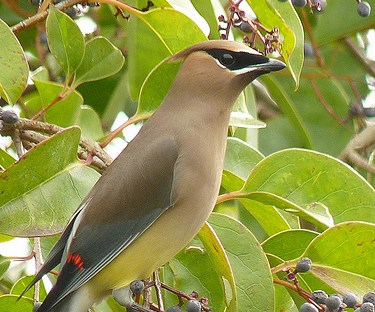
Pick a species-targeted route, for example the Cedar Waxwing on Page Street from Market to Golden Gate Park, then find the recommended plants for that route in the SF Plant Finder. You’ll get tons of information about whether those plants will work in your particular space. Or alternatively, drop a pin on the map for a big grid of potential plants for your location, and whittle it down with filters for your space (sandy soil? Part shade?) and goals (nectar-producing? Small size?).

The location specificity of the SF Plant Finder makes it unique as a resource. “San Francisco is a small place, so you’d think that plant choices might be pretty much the same across it, but in fact the number of microclimates is staggering,” says Baier. With SF Plant Finder you can focus on a particular point on the map, and you’ll be choosing from plants that will all fit with the existing environment, rather than fighting against it.

Spring Birds

In spring, San Francisco’s backyard spaces, which collectively cover more land than all our public open spaces combined, become an especially crucial resource for our city’s avian population. In preparation and response, the landscape designers and gardeners of Rooted SF, San Francisco’s new nature-oriented business collective, are making garden tweaks that support bird presence.

“I want the gardens I build to be havens for both people and birds,” says Rooted SF member Trina Lopez. “Our brains evolved to interpret bird song as pleasant and reassuring, so bird presence just bolsters the mental health benefits of a garden.”

San Francisco is home to dozens of resident bird populations, who are typically breeding in the spring, but is also a link in the Pacific Flyway, a massive north-south biannual migration route for dozens more bird species.

Rooted SF member Elisa Baier makes simple changes in gardens where owners want to support bird life. “It can be as easy as letting a twiggy shrub stay unpruned for the spring to give plenty of bird shelter,” says Baier. “Gardening for birds often just means keeping your garden a little wilder.”

For longer-term efforts, Baier suggests choosing a variety of seed- and nectar-producing plants, such as toyon and sages, to attract birds with varying feeding habits. A focus on creating varying height and some areas of dense foliage will make the space appealing to birds.

Green connections plant finder

Efforts to protect and create urban habitat are getting a boost this spring via the SF Plant Finder, a new searchable database of plants that can be used to support key species living in SF. The SF Plant Finder is the newest release in SF Planning Department’s Green Connections Plan, launched in 2014 in collaboration with Nature in the City, SF Parks Alliance, and Walk San Francisco. The Green Connections Plan aims to build a network of connected streets that are designed, planted, and beautified to make traveling through SF by foot or bike more pleasant and viable.

The SF Plant Finder targets the dovetailed goal of making those “green connectors” into habitat for key wild species. Residents on or near the 24 Green Connections habitat routes can use this tool to make informed planting choices.

“I often find that it’s easier to connect with your own personal garden space if you can think about its role in a larger picture,” says Small Spot Gardens owner Elisa Baier. “The SF Plant Finder is a super approachable way to do that.”

Pick a species-targeted route, for example the Cedar Waxwing on Page Street from Market to Golden Gate Park, then find the recommended plants for that route in the SF Plant Finder. You’ll get tons of information about whether those plants will work in your particular space. Or alternatively, drop a pin on the map for a big grid of potential plants for your location, and whittle it down with filters for your space (sandy soil? Part shade?) and goals (nectar-producing? Small size?).

The location specificity of the SF Plant Finder makes it unique as a resource. “San Francisco is a small place, so you’d think that plant choices might be pretty much the same across it, but in fact the number of micro-climates is staggering,” says Baier. With SF Plant Finder you can focus on a particular point on the map, and you’ll be choosing from plants that will all fit with the existing environment, rather than fighting against it.